In a Hurry? Key Takeaways
Whether to build an in-house editing team or outsource to specialist freelancers depends on your volume, consistency requirements, margin targets, and how much production risk you are willing to own.
Full employment cost calculation including all overhead
Monthly utilization tracker by editor
Style guide for outsourced editors
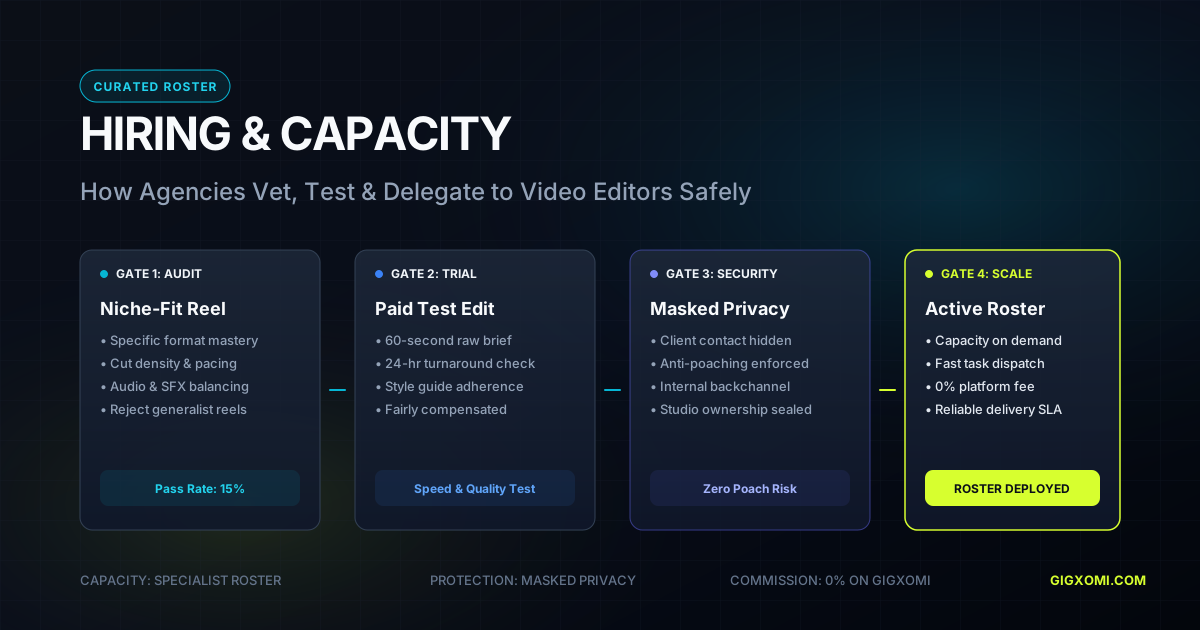
Outsourced editor vetting criteria and test edit process
Scale Your Video Editing Agency With Zero Chaos
Manage freelance editors, streamline revisions, protect clients with two-lane masked messaging, and retain 100% of your earnings. No hidden fees, no marketplace middleman cuts.
Cost structure: fixed overhead versus variable production cost
An in-house editor is a fixed cost. Salary, benefits, software licenses, and hardware depreciation occur at the same rate whether the team is at 100% utilization or 40% utilization. Outsourced editors are a variable cost: you pay when there is work and stop when there is not. For agencies with inconsistent project volume, outsourcing preserves margin during slow months that would otherwise be spent paying for idle capacity.
The crossover point typically occurs when you have enough consistent work to keep an in-house editor above 80% utilization every single month. Below that threshold, outsourcing is almost always more cost-effective when you account for the full employment cost rather than just the gross salary figure.
- Calculate the full employment cost including tax, software, hardware, and benefits before comparing to freelance day rates.
- Track monthly utilization over three months before making a hiring decision.
- Below 80% consistent utilization, outsourcing is typically cheaper on a total cost basis.
Quality control: consistency versus specialization
An in-house editor develops deep familiarity with your clients' brands, style guides, and preferences. This familiarity reduces revision counts over time and allows the editor to anticipate client preferences rather than react to feedback. Outsourced editors produce consistent quality from day one of a new format but require a thorough style guide and onboarding checklist to match the standard an in-house editor achieves through accumulated client knowledge.
For high-volume retainers with one or two anchor clients, an in-house editor's familiarity advantage is significant. For agencies with ten or more clients in different niches, outsourced specialists in each niche often produce better initial quality than a single generalist in-house editor stretched across multiple formats and platforms.
The hybrid model for scaling agencies
Most growing agencies settle on a hybrid approach: one in-house senior editor who owns quality standards, manages the brief process, and handles the highest-value anchor clients; and a vetted pool of outsourced specialists who handle volume overflow, niche format requests, and peak demand periods. The in-house editor becomes a quality gate rather than the primary production resource for all client work.
This model scales without the fixed cost risk of a second full-time hire and without the quality inconsistency of a fully outsourced roster with no internal oversight or quality control layer.
What To Check Before You Decide
- Full employment cost calculation including all overhead
- Monthly utilization tracker by editor
- Style guide for outsourced editors
- Outsourced editor vetting criteria and test edit process
- Hybrid model workflow documentation
Comparison Table
| Option | Best for | Tradeoff | Gigxomi angle |
|---|---|---|---|
| Fully in-house team | Agencies with one or two anchor clients and consistently high volume | Fixed cost regardless of utilization level | Supplement with outsourced overflow capacity rather than a second full-time hire. |
| Fully outsourced production | Early-stage agencies and variable-volume operations | Quality consistency requires strong style guides and onboarding | Gigxomi's vetted editor pool gives you specialist access without fixed monthly overhead. |
| Hybrid model (in-house QA + outsourced production) | Growing agencies scaling past two anchor clients | Requires a competent senior in-house editor as quality gate | The most scalable model for agencies targeting 10 or more concurrent clients. |
Action Steps for in-house vs outsourced video editing
- Calculate your full monthly in-house editor cost including all employment overhead.
- Track actual editor utilization for the last three consecutive months.
- If utilization is below 80%, model the cost difference of outsourcing the same volume.
- If utilization consistently exceeds 80%, build a style guide and overflow pool before hiring full-time.
- Consider the hybrid model: one in-house quality gate with a vetted outsourced production pool.
The Video Editing Agency Delivery Engine
How modern studios scale client capacity without founder micro-management or poaching risk:
Omnichannel Inbound
WhatsApp & Instagram DM leads arrive in Unified Inbox
Qualification & Quote
Manager scores scope, prices deal & sends quote link
Two-Lane Masked Chat
Editor receives brief; client phone is 100% encrypted
Review & Approval
Client approves rough cut with gated revision limits
0% Commission Payout
Agency keeps 100% of fees; auto-renewal locked
Anti-Poaching Guarantee: Editors never see raw client phone numbers or direct payment links. All communication is relayed via encrypted tokens, protecting your agency's client equity permanently.
Put the Process Into Practice
Gigxomi helps video-editing agencies and studio owners keep client context, manager delegation, editor assignments, reviews, delivery, and payout visibility connected. Use this guide to structure your process; use the workspace when that process requires shared ownership and a reliable operating record.
You can also read our in-depth video editing agency management software guide, or review agency workspace pricing.
Continue Your Plan
Build Your Hybrid Team on Gigxomi
Gigxomi's vetted editor pool and Two-Lane masked chat gives you the hybrid model: in-house quality control with outsourced production capacity at 0% commission. WhatsApp concierge: +91 99933 28124.
Frequently Asked Questions
At what revenue level should I hire a full-time in-house video editor?
When you can guarantee at least 80% utilization every month for 12 consecutive months, a full-time in-house editor typically becomes cost-effective on a total cost basis. Below that threshold, outsourcing or a part-time arrangement is usually cheaper when you account for all employment costs including overhead.
How do I maintain quality with multiple outsourced video editors?
Create a detailed style guide covering pacing, music selection, colour grade reference, caption formatting, lower third style, export specifications, and file naming conventions. Run every outsourced editor through a paid test edit on a realistic brief before assigning any live client project work.
What is the biggest risk of outsourcing video editing?
The biggest risks are client contact exposure and IP leakage to the freelancer. Use a platform with masked communication channels so outsourced editors never interact directly with your clients, and ensure your contract with every editor explicitly assigns all IP rights to your agency.