In a Hurry? Key Takeaways
The comprehensive blueprint for lead video editors scaling into an agency: how to manage freelance editors, structure two-lane masked communication, build a vetted team, stop client poaching, and maintain 60%+ profit margins.
Identify the exact capacity bottleneck where solo editing must transition to team delegation
Implement the 3-tier production hierarchy: Lead Editor, Associate Cutter, and Asset Specialist
Deploy Two-Lane Masked Communication to structurally eliminate client poaching and disintermediation
Standardize the 4-gate review funnel to catch errors before clients ever see a rough cut
Scale Your Video Editing Agency With Zero Chaos
Manage freelance editors, streamline revisions, protect clients with two-lane masked messaging, and retain 100% of your earnings. No hidden fees, no marketplace middleman cuts.
The Solopreneur Ceiling: When Solo Video Editing Must Become an Agency
Every high-performing freelance video editor inevitably hits the same invisible ceiling. You master your editing software, refine your storytelling pacing, curate an impressive portfolio, and begin winning high-paying creator and brand clients. Within six to twelve months, your client roster swells from two retainers to seven. Suddenly, you are billing $6,000 to $12,000 each month—but you are working 75 to 90 hours every week. Your physical capacity is exhausted. You spend your mornings cutting rough timelines, your afternoons hunting down missing client assets in Google Drive folders, your evenings chasing invoice payments, and your nights answering frantic WhatsApp messages from clients asking for urgent revisions. If you take a single weekend off or fall ill for three days, client delivery halts, deadlines collapse, and your income stops immediately.
At this exact juncture, most editors make a fatal mistake: they try to work faster, drink more caffeine, and compress their sleep. This guarantees creative burnout, degraded editing quality, and lost clients. The only sustainable path forward is transitioning from a solo technician into a lead editor who directs, delegates, and oversees other editors. However, managing other editors is a completely different discipline from cutting video yourself. When you edit alone, all communication, creative context, file organization, and brand preferences reside inside your own head. The moment you hand raw footage to another editor, every unwritten assumption, ambiguous brief, and disorganized folder becomes an expensive mistake.
Generic project management tools like Notion, Asana, Trello, and ClickUp are fundamentally unsuited for this transition. They are general-purpose databases designed for corporate marketing teams, software developers, and copywriters. They do not understand 4K video proxy workflows, timecode-accurate feedback, aspect ratio safe zones, audio loudness normalization (-14 LUFS), or the delicate dynamics of client relationships. Even worse, generic task managers force you to expose client contact details directly to your freelance editors, exposing your business to the existential risk of client poaching. To build a resilient, scalable video editing agency, lead editors require specialized video editing agency management software that merges client communication, production delegation, review gates, and payout infrastructure into a unified, secure system.
- The 60-hour burnout trap: why skilled solo editors fail when trying to brute-force agency volume alone
- The breakdown of generic tools: why Asana and Notion collapse under heavy video production demands
- The transition mindset: moving from timeline technician to creative director and agency operator
- The four operational pillars: client acquisition, masked delegation, quality control, and cash-flow management
The Core Operating Architecture: Systems to Build a Video Editing Agency
Building a sustainable video editing agency requires an operating architecture that operates predictably whether you are actively sitting at your desk or not. An agency is not defined by having a fancy company logo or a slick landing page; an agency is a documented, repeatable system that reliably transforms raw client footage into approved, billable deliverables while preserving healthy profit margins. This architecture relies on a clear three-tier production hierarchy: the Lead Editor / Creative Director, the Associate / Rough-Cut Editor, and the Technical / Asset Specialist.
The Lead Editor (the agency founder) should never spend their valuable billable hours sorting through three hours of unorganized A-roll, synchronizing multi-camera audio tracks, or cutting out verbal pauses and dead air. These mechanical, low-leverage tasks should be delegated to hungry, competent associate editors. The associate editor receives the raw footage, applies the project brief, builds the rough timeline assembly, selects the strongest takes, and establishes the foundational narrative rhythm. Once this rough cut passes internal inspection, the lead editor steps in to perform high-leverage creative direction: fine-tuning emotional pacing, adding signature narrative transitions, and verifying brand alignment.
For complex recurring content, specialized sub-tasks can be routed to dedicated specialists. Kinetic typography, custom motion graphics, sound design sweeps, and color grading can be handled by asset specialists who excel in those specific domains. When an agency structures production into modular, repeatable stages, individual editor capacity becomes predictable. Instead of guessing how many videos your agency can deliver this month, you can mathematically forecast capacity based on editor throughput: an associate editor can reliably produce 8 to 12 rough assemblies per week, while a lead editor can supervise and finalize 25 to 35 completed videos per week across multiple client accounts.
- The 3-tier hierarchy: Lead Editor (direction), Associate Editor (assembly), and Specialist (graphics/audio)
- Modular task decomposition: separating ingest, rough cut, motion styling, sound mixing, and final export
- Capacity mathematical modeling: establishing realistic weekly output bands per editor without quality loss
- Standardized intake protocols: enforcing strict client submission deadlines before production clocks start
The Anti-Poaching Architecture: Why Two-Lane Masked Communication Is Essential
The single greatest vulnerability in traditional creative outsourcing is disintermediation, commonly known as client poaching. Consider the standard, flawed agency workflow: a client messages the agency founder on WhatsApp requesting five Reels. The founder creates a shared WhatsApp group or invites the client and a freelance editor into a shared Slack channel or Notion board. The freelance editor sees the client's direct phone number, company name, and project budget. Within weeks, the freelance editor privately direct-messages the client on Instagram or WhatsApp: ‘Hey, I noticed the agency charges you $1,500 a month for these videos. I am the one actually doing all the editing. If you work with me directly, I will do it for $800.’
Because the client wants to save money and the freelance editor wants higher direct pay, the agency owner is abruptly cut out of the relationship. The agency owner loses a loyal monthly retainer, suffers immediate revenue loss, and has effectively trained their own competitor using their own client relationships. Non-disclosure agreements (NDAs) and non-compete contracts offer virtually zero protection against this dynamic, particularly when hiring talented freelance editors across international borders where legal enforcement is practically impossible and financially unfeasible.
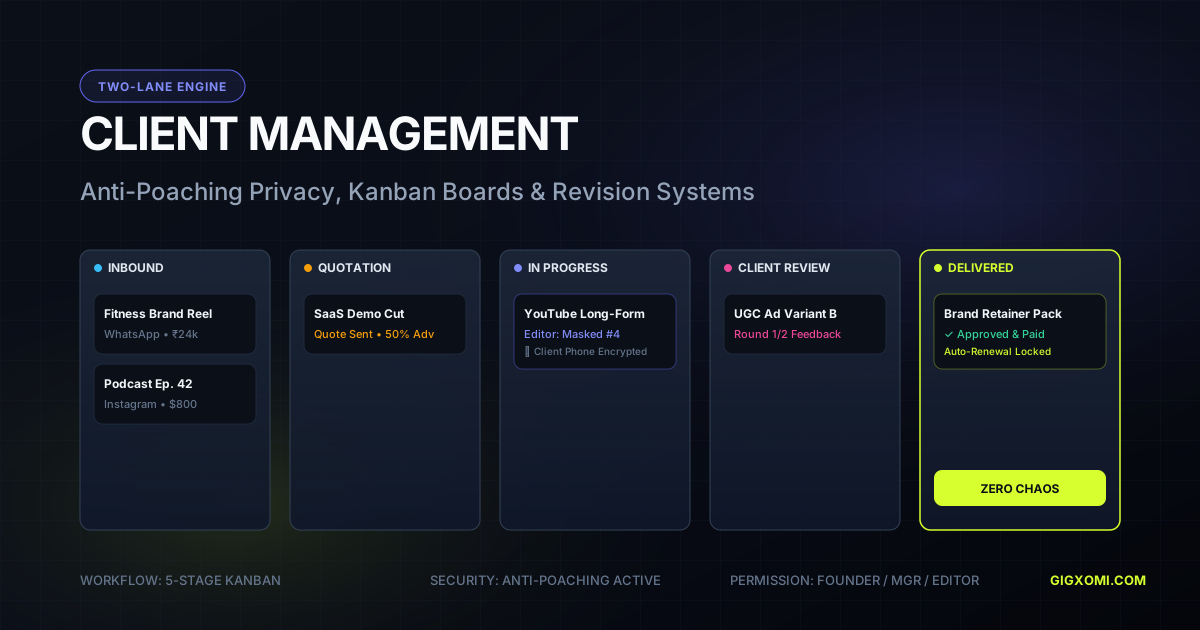
The only foolproof solution to client poaching is architectural security: Two-Lane Masked Communication. Inside a purpose-built video editing agency management tool like Gigxomi, the client and the freelance editor operate in two completely isolated, parallel communication lanes. Lane 1 is the Client Relay: the client communicates exclusively with the agency brand through their preferred channel (such as WhatsApp Business or Instagram Direct). Lane 2 is the Production Relay: the freelance editor receives detailed assignment cards, timecoded creative briefs, raw footage download links, and revision checklists inside the workspace. The editor never sees the client’s real phone number, email address, or social handles. Client inquiries and editor submissions pass through the agency dashboard, preserving complete agency ownership of the client relationship forever.
- The disintermediation hazard: why shared WhatsApp groups and open Slack channels destroy agency equity
- The legal illusion: why international NDAs fail to stop offshore editors from poaching agency accounts
- Two-Lane Relay mechanics: how masked communication isolates client contact information from production staff
- Permanent account retention: ensuring your client roster remains an agency asset that compounds in enterprise value
The Quality Control Funnel: 4-Gate Review System to Eliminate Scope Creep
Quality inconsistency is the primary reason clients churn from video editing agencies. When a client hires an agency, they expect every delivery to match the high standard of the founder's original portfolio. However, freelance editors have varying artistic habits, differing audio monitoring environments, and disparate interpretations of pacing. If an agency delivers an unpolished cut containing misspelled captions, un-normalized audio, or incorrect aspect ratios directly to the client, the client immediately questions why they are paying agency premiums. To prevent this, every project must pass through a strict four-gate review funnel before final delivery.
Gate 1 is Ingest and Brief Verification. Before an editor cuts a single frame, the project brief is audited against client requirements: are the brand fonts, color hex codes, vector logos, and reference links present? Is the raw footage complete, or are audio stems missing? Gate 2 is the Internal Rough-Cut Gate. The associate editor submits Version 1 exclusively to the agency's internal review queue. The lead editor or post-production manager inspects the edit with timecode precision: does the opening hook grab attention within the first 2 seconds? Is the narrative structure coherent? Are verbal stumbles removed? Any deficiencies are bounced back to the editor for internal correction. The client never sees Version 1.
Gate 3 is the Structured Client Review Gate. Once the internal team approves Version 2, the video is presented to the client through a clean, branded review portal. Clients are required to submit consolidated feedback with timecoded notes, eliminating vague complaints like ‘make it pop’ or contradictory notes from multiple stakeholder managers. Gate 4 is the Master Delivery and Archive Gate. The final approved video is exported with strict technical standards: correct bitrate, REC.709 color space, -14 LUFS integrated audio, and platform-specific metadata. The project file (.prproj, .drp) and assets are archived systematically, ensuring that any future revision or template update can be retrieved in minutes.
- Gate 1: Ingest verification and asset completeness audit before editing begins
- Gate 2: Internal review gate where lead editors correct rough cuts before client visibility
- Gate 3: Consolidated client feedback collection with precise timecoded revision rules
- Gate 4: Master delivery technical validation and structured project archive management
Video Editing Team Building Tool: Sourcing, Vetting, and Retaining Top Editors
An agency's delivery throughput is strictly limited by the caliber of its editing team. However, traditional hiring methods—posting a generic job listing on Upwork, Fiverr, or Reddit—attract hundreds of low-effort applications containing recycled showreels, stolen portfolio pieces, and false skill claims. Evaluating candidates solely based on their polished showreel is a recipe for disaster, because a showreel represents cherry-picked footage worked on over months, often with heavy assistance or copied tutorial templates. It tells you nothing about an editor's speed, file discipline, or ability to follow a client brief under pressure.
The modern video editing team building methodology relies on a standardized, paid technical trial. Never ask candidates to work for free, as top-tier editors will rightly refuse. Instead, create a standardized 30-minute editing challenge using a real 3-minute raw footage sample from a past agency project. Provide a standardized brief, raw footage, an audio track, and brand assets. Measure the candidate on four objective criteria: turnaround speed, adherence to naming conventions, narrative pacing instinct, and technical polish (clean caption line breaks, safe-zone compliance, and balanced audio levels). An editor who completes the trial cleanly within 48 hours without asking redundant questions is an immediate hire.
Once vetted, editor retention depends on predictable compensation and respectful operating workflows. Lead editors should utilize tiered compensation structures: a competitive per-minute or per-deliverable flat rate for standard turnaround, with explicit rush bonuses for emergency 24-hour delivery. As editors prove consistency across twenty consecutive projects, transition them to guaranteed monthly retainer capacity bands (e.g., $1,200/month for 15 dedicated short-form deliverables). By offering steady, predictable monthly income without bidding wars or 20% platform marketplace cuts, your agency becomes the most desirable employer in the editor's roster.
- The showreel trap: why portfolio reels lie and how to spot stolen editing credentials
- The 30-minute paid trial: the objective, low-risk testing framework that weeds out 90% of pretenders
- Tiered compensation design: balancing per-project fees with guaranteed monthly retainer stability
- Building the emergency bench: maintaining 3 to 5 vetted on-call backup editors for peak client surges
Financial Engineering & Pricing Models: Maximizing Agency Unit Economics
A video editing agency that delivers exceptional creative work will still go bankrupt if its unit economics are poorly structured. Many lead editors make the mistake of pricing their services based on cost-plus math: ‘If my freelance editor charges me $40 per video, I will charge the client $60.’ This razor-thin 33% gross margin leaves zero room for project management overhead, revision cycles, software subscriptions, transaction fees, or client churn. A single difficult revision round or delinquent invoice completely erases project profitability.
Healthy, enterprise-grade video editing agencies target a minimum of 55% to 70% gross profit margin on every recurring engagement. To achieve this, lead editors must package services into recurring monthly value retainers rather than transactional hourly billing. For example, a monthly ‘Executive Personal Brand Engine’ deliverable consisting of 16 short-form Reels/Shorts and 2 long-form YouTube videos should be priced at $2,500 to $4,000 per month. Fulfilling this package requires approximately $800 to $1,200 in associate editor compensation and $200 in software and storage overhead, leaving the agency with $1,500 to $2,600 in net gross profit per client every single month.
Managing agency cash flow also demands strict billing terms. Never deliver final unwatermarked master exports on net-30 or net-60 invoice terms. Enforce 100% upfront monthly billing for recurring retainers, or 50% deposit / 50% upon rough cut approval for bespoke commercial projects. By leveraging agency software with built-in zero-commission payment handling and integrated financial tracking, lead editors eliminate the 15% to 20% commission deductions extracted by traditional freelance marketplaces, directly boosting the agency founder's bottom line.
- The 60%+ gross margin rule: how to calculate true cost of delivery including management overhead
- Retainer packaging frameworks: moving away from hourly rates into high-ticket monthly content packages
- Strict cash-flow discipline: upfront billing, milestone locks, and automated recurring payment collection
- The zero-commission advantage: retaining 100% of client revenues without marketplace platform penalty
The Modern Agency Stack: Why Dedicated Agency Software Beats Disjointed SaaS
As your video editing team expands beyond three editors and five concurrent clients, operating across a fragmented web of disconnected software becomes an administrative nightmare. A typical disorganized agency pays for five separate SaaS tools: Slack for internal team chat ($8/user/mo), Frame.io for video review ($15/user/mo), Asana for task cards ($13/user/mo), Google Workspace for cloud storage ($18/user/mo), and Stripe/PayPal taking 3% to 4% on invoices. Information is constantly fragmented across these silos: client brief updates get buried in Slack threads, revision requests get lost in Frame.io comments, and editor deadlines slip because tasks are disconnected from real-time chat.
Worse still, none of these disparate tools communicate natively with the primary client acquisition channels where actual clients spend their time: WhatsApp and Instagram. When a high-ticket founder or marketing director sends an urgent video brief via WhatsApp, the agency owner is forced to manually copy text, download video attachments, create an Asana task, upload the footage to Google Drive, and tag an editor in Slack. This manual copy-pasting consumes two to three hours every day and introduces critical errors at every handoff.
Dedicated video editing agency management software like Gigxomi consolidates this entire operational pipeline into a purpose-built workspace. Inbound inquiries from WhatsApp Business and Instagram Direct flow directly into a centralized agency inbox. Leads are converted into active projects with a single click. Editors are assigned directly to deliverables with Two-Lane communication masking. Internal rough cuts are reviewed and approved within the same interface. Final deliverables are delivered with complete audit trails, and payouts are tracked transparently without platform cuts. By replacing fragmented generalist tools with purpose-built video editing agency software, lead editors reclaim 15+ hours each week to focus on high-value business development, client strategy, and agency scaling.
- The SaaS fragmentation tax: the hidden cost of juggling Slack, Asana, Frame.io, and Google Drive
- Unified client-to-delivery pipeline: connecting WhatsApp inquiries directly to production assignment boards
- Centralized audit trails: maintaining an unbroken history of briefs, versions, approvals, and editor compensation
- The 30-day scaling roadmap: step-by-step checklist to migrate your freelance workflow into an agency workspace
What To Check Before You Decide
- Identify the exact capacity bottleneck where solo editing must transition to team delegation
- Implement the 3-tier production hierarchy: Lead Editor, Associate Cutter, and Asset Specialist
- Deploy Two-Lane Masked Communication to structurally eliminate client poaching and disintermediation
- Standardize the 4-gate review funnel to catch errors before clients ever see a rough cut
- Use standardized paid technical trials to build a dependable bench of specialized editors
- Price recurring monthly retainers to guarantee 55% to 70% gross agency profit margins
- Consolidate fragmented toolchains into dedicated video editing agency management software
Comparison Table
| Option | Best for | Tradeoff | Gigxomi angle |
|---|---|---|---|
| Fragmented SaaS (Slack + Asana + Frame.io) | Tech-savvy teams with heavy administrative time | High software costs, zero anti-poaching masking, and disconnected WhatsApp client chats | Unified agency workspace with built-in Two-Lane masked chat and zero platform commission |
| Freelance Marketplaces (Upwork / Fiverr) | One-off gig discovery and quick ad-hoc cuts | High 20% platform fees, no brand equity, and high risk of client poaching | Private agency environment where you own your client relationships and retain 100% of revenue |
| Dedicated Agency Software (Gigxomi) | Lead video editors managing other editors and scaling client retainers | Requires establishing structured review gates and clear editor briefs | Built specifically for video editors: masked client relays, editor assignment, and agency scale |
Action Steps for video editing agency management software
- Audit your current weekly hours and map the repetitive editing tasks ready for delegation.
- Deploy Two-Lane Masked Communication to separate client conversations from editor production handoffs.
- Create a standardized 30-minute paid technical trial to evaluate incoming editor candidates.
- Implement the 4-gate review funnel to catch mistakes internally before client presentation.
- Package your editing services into recurring monthly retainers targeting 60%+ gross margins.
- Enforce 100% upfront monthly billing to insulate agency cash flow against late payments.
- Consolidate fragmented tools into dedicated video editing agency management software.
The Video Editing Agency Delivery Engine
How modern studios scale client capacity without founder micro-management or poaching risk:
Omnichannel Inbound
WhatsApp & Instagram DM leads arrive in Unified Inbox
Qualification & Quote
Manager scores scope, prices deal & sends quote link
Two-Lane Masked Chat
Editor receives brief; client phone is 100% encrypted
Review & Approval
Client approves rough cut with gated revision limits
0% Commission Payout
Agency keeps 100% of fees; auto-renewal locked
Anti-Poaching Guarantee: Editors never see raw client phone numbers or direct payment links. All communication is relayed via encrypted tokens, protecting your agency's client equity permanently.
Put the Process Into Practice
Gigxomi helps video-editing agencies and studio owners keep client context, manager delegation, editor assignments, reviews, delivery, and payout visibility connected. Use this guide to structure your process; use the workspace when that process requires shared ownership and a reliable operating record.
You can also read our in-depth video editing agency management software guide, or review agency workspace pricing.
Continue Your Plan
Build Your Video Editing Agency on Gigxomi
Stop juggling WhatsApp groups and risky freelance handoffs. Gigxomi gives lead video editors the dedicated agency management software to assign cuts, review revisions, and protect client relationships with Two-Lane masked communication. 0% platform commission. WhatsApp onboarding concierge: +91 99933 28124.
Frequently Asked Questions
What is video editing agency management software?
Video editing agency management software is a specialized workspace designed for lead video editors and post-production managers who coordinate multiple freelance editors. Unlike generic tools like Asana or Trello, it combines Two-Lane masked communication (stopping client poaching), timecoded video review gates, editor assignment boards, and client inquiry relays (WhatsApp & Instagram) into one unified system.
How do I manage freelance video editors without them poaching my clients?
The only reliable way to prevent client poaching is using Two-Lane Masked Communication. Inside a system like Gigxomi, your clients communicate exclusively with your agency brand via WhatsApp or Instagram, while your freelance editors receive assignment briefs, footage links, and revision requests inside a secure workspace without ever seeing the client's direct contact information.
How many editors should a lead editor manage?
A single lead editor can comfortably supervise and quality-control 3 to 6 associate editors when backed by a structured review funnel. This team size allows the agency to deliver 30 to 60 polished videos per week while preserving high creative standards and allowing the founder to focus on client acquisition.
What profit margin should a video editing agency target?
A healthy video editing agency should target a 55% to 70% gross profit margin. For a $3,000/month client retainer, total editor fulfillment costs should range between $900 and $1,200, leaving $1,800 to $2,100 in gross margin to cover operating overhead and founder profits.
What is the best system to build a video editing agency from scratch?
The proven system to build a video editing agency is: (1) Standardize a single high-demand service package (e.g., weekly YouTube episodes or daily Reels); (2) Create a standardized paid trial to vet 2 to 3 associate editors; (3) Implement Two-Lane masked chat to protect client contacts; (4) Use a 4-gate review funnel to guarantee delivery consistency; and (5) Bill retainers upfront.
How is Gigxomi different from Frame.io or Notion for managing video editing teams?
Frame.io is strictly a video review and timecode commenting player, lacking client invoicing, masked communication, and lead routing. Notion is a blank-slate database requiring hours of manual configuration without native chat. Gigxomi is an all-in-one agency management software built specifically for video editors managing other editors, featuring built-in masked communication, editor assignment, and zero commission fees.
How do I transition from editing solo to running an agency team?
Start by documenting your personal editing workflow into step-by-step SOPs. Hire your first associate editor to take over rough-cut assemblies while you retain final polish and client communication. Once that editor is consistent, add a second editor and transition completely to creative direction and business development.