In a Hurry? Key Takeaways
The review and approval process is where most video editing agencies lose time, margin, and client trust. A structured gate prevents unlimited revisions, clarifies who can approve, and keeps production moving on schedule.
Single approval owner documentation
Timestamped structured feedback form
Revision count tracker per phase
Revision limit clause in service agreement
Scale Your Video Editing Agency With Zero Chaos
Manage freelance editors, streamline revisions, protect clients with two-lane masked messaging, and retain 100% of your earnings. No hidden fees, no marketplace middleman cuts.
Define the approval authority before production starts
The most common review problem in video editing agencies is not too many revisions — it is too many reviewers. When four stakeholders can each request changes independently, the editor receives conflicting instructions and the project stalls indefinitely. Before the kickoff call, identify the single approval owner on the client side: one person whose sign-off advances the project to the next production phase. Everyone else contributes feedback to that owner rather than submitting directly to the agency.
Document this in the brief and confirm it in the service agreement. A clause that names the approval owner and limits changes after sign-off protects your team from endless revision loops driven by late-arriving internal feedback from stakeholders who were not involved during the review window.
- Name one approval owner per project at the kickoff call without exceptions.
- Specify in writing that changes submitted after the review window closes are billed as additional revisions.
- Confirm the approval process applies to every production phase, not just the final cut.
Collect actionable feedback rather than vague impressions
Vague feedback — 'it does not feel right' or 'can we make it more dynamic' — forces the editor to guess and almost always results in another revision round. Before sharing a review link, give the client a short feedback form: timestamp, what they want changed, and their preferred alternative. This converts impressions into actionable instructions the editor can implement without a clarification call.
Use a shared document with a table: timestamp, feedback description, priority level (must-fix or nice-to-have), and approved status. When the client submits feedback in this structured format, the editor knows exactly what to address and the agency can track how many changes were requested versus what the contract allows.
Enforce revision limits without creating conflict
Revision limits fail when they are enforced reactively. The editor finishes revision three, then the client asks for revision four, and the agency must create conflict to enforce the contract clause. Instead, communicate the revision count proactively: after revision two, send a note that one revision remains in the current phase. This gives the client an opportunity to consolidate remaining feedback rather than discovering the limit after they have already submitted additional requests.
When the limit is reached, offer a fixed-price additional revision package rather than a flat refusal. This converts a potential dispute into a commercial conversation and demonstrates good faith toward a client relationship that has long-term retainer potential.
What To Check Before You Decide
- Single approval owner documentation
- Timestamped structured feedback form
- Revision count tracker per phase
- Revision limit clause in service agreement
- Additional revision pricing sheet
Comparison Table
| Option | Best for | Tradeoff | Gigxomi angle |
|---|---|---|---|
| Unlimited revisions | No scenario — destroys margins | Creates scope creep on every project without exception | Define the revision limit at contract stage and track count per phase with a log. |
| Fixed revision limit, never enforced | Avoiding short-term conflict | Limit becomes meaningless after the first breach | Proactive revision-count notification prevents disputes before they arise. |
| Fixed limit with proactive count communication | Agencies with multiple concurrent clients | Requires a tracking system across all projects | Gigxomi workspace tracks revision requests and approval status per project automatically. |
Action Steps for client review and approval process video editing
- Identify and document the single approval owner per project before the kickoff call.
- Create a structured feedback form with timestamp, change request, and priority fields.
- Communicate remaining revision count before the final revision is submitted.
- Offer a fixed-price revision extension rather than refusing additional changes outright.
- Log every revision request, approval date, and approval owner in the project record.
The Video Editing Agency Delivery Engine
How modern studios scale client capacity without founder micro-management or poaching risk:
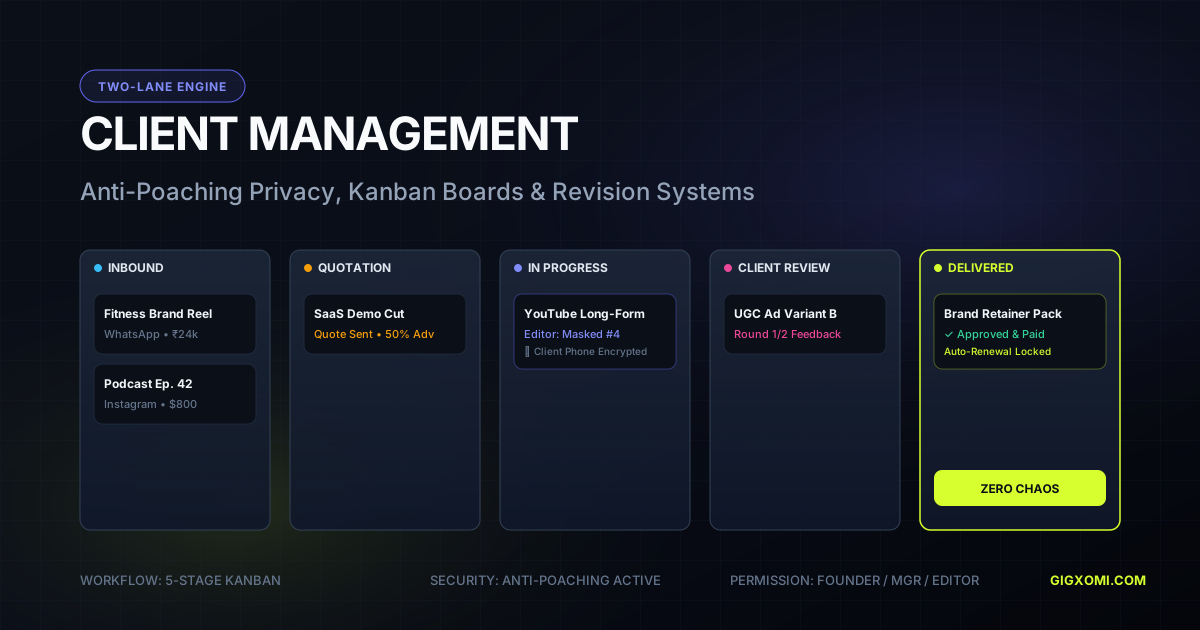
Omnichannel Inbound
WhatsApp & Instagram DM leads arrive in Unified Inbox
Qualification & Quote
Manager scores scope, prices deal & sends quote link
Two-Lane Masked Chat
Editor receives brief; client phone is 100% encrypted
Review & Approval
Client approves rough cut with gated revision limits
0% Commission Payout
Agency keeps 100% of fees; auto-renewal locked
Anti-Poaching Guarantee: Editors never see raw client phone numbers or direct payment links. All communication is relayed via encrypted tokens, protecting your agency's client equity permanently.
Put the Process Into Practice
Gigxomi helps video-editing agencies and studio owners keep client context, manager delegation, editor assignments, reviews, delivery, and payout visibility connected. Use this guide to structure your process; use the workspace when that process requires shared ownership and a reliable operating record.
You can also read our in-depth video editing agency management software guide, or review agency workspace pricing.
Continue Your Plan
Streamline Reviews on Gigxomi
Gigxomi's Two-Lane workspace routes client feedback to the right editor without exposing client contact details. 0% commission. Track revision counts per project. WhatsApp concierge: +91 99933 28124.
Frequently Asked Questions
How many revisions should a video editing contract include?
Two rounds of revisions per deliverable is standard for most agency contracts. Complex multi-platform projects may allow three rounds. The limit should be specified per production phase (rough cut, colour grade, sound mix) rather than as a vague total across the entire project.
What if the client refuses to approve without unlimited changes?
This is a commercial negotiation rather than a creative one. Offer a clearly priced revision package and document the conversation in writing. If the client cannot work within a defined revision structure, they are unlikely to be a sustainable retainer client worth pursuing.
How do I handle conflicting feedback from multiple stakeholders?
Direct all feedback through the named approval owner and refuse to act on unsolicited feedback from non-approvers. When multiple stakeholders submit conflicting requests, ask the approval owner to consolidate and prioritise before the editor makes any changes.