Executive Summary & Takeaways
In a growing video production business, operational chaos is the primary bottleneck to scaling. When creative assets are dumped into unorganized Google Drive folders, project files get misplaced, or editors guess client style guidelines, agency margins evaporate. Building scalable video editing agency sops transforms r
Target Audience & Distribution Channel: YouTube 16:9 cinematic vs. TikTok/Reels 9:16 high-pace retention edit.
Brand Style Guide: Exact hex color codes, typography files (.otf/.ttf), and safe margins for platform UI overlays.
Retention Rhythm Benchmarks: Specific pacing references (e.g., Ali Abdaal explanatory kinetic motion vs. Hormozi high-cadence subtitles).
Pacing Outline: Hook timestamp, chapter breakdown, core thesis, and closing Call-to-Action (CTA).
In a growing video production business, operational chaos is the primary bottleneck to scaling. When creative assets are dumped into unorganized Google Drive folders, project files get misplaced, or editors guess client style guidelines, agency margins evaporate. Building scalable video editing agency sops transforms random freelance chaos into a predictable, high-margin production assembly line.

1. Phase 1: Raw Ingestion & Asset Directory Hygiene
Every single project begins with rigid directory structure enforcement before an editor opens Premiere Pro, DaVinci Resolve, or Final Cut. Create an automated zip archive or master folder template with the following immutable hierarchy:
[Client_Code]_[Project_Name]_[YYYYMMDD]/
|-- 01_RAW_FOOTAGE/ (A-Roll, B-Roll, Screen_Captures, Drone)
|-- 02_AUDIO/ (Lavalier, Boom, Zoom_H6, SFX, Licensed_Music)
|-- 03_GRAPHICS_ASSETS/ (Logos, Lower_Thirds, Font_Files, Brand_Palette)
|-- 04_PROJECT_FILES/ (Premiere, AfterEffects, DaVinci_Archive)
|-- 05_PROXIES/ (720p or 1080p ProRes Proxy or DNxHR)
|-- 06_EXPORTS_REVIEW/ (V01_WIP, V02_WIP)
`-- 07_FINAL_DELIVERY/ (Master_4K_ProRes, Web_H264_1080p, Social_9x16)
Enforce file naming conventions immediately upon download. Never allow file names like IMG_4921.MOV to reach the timeline. Scripts or ingestion assistants batch-rename clips with dates and camera angles to prevent missing link errors during team handoffs.
2. Phase 2: Creative Briefing and Assembly Cut Protocol
Editors should never begin cutting without a signed creative brief. The briefing SOP requires the account manager to pin four items to the task ticket:
- Target Audience & Distribution Channel: YouTube 16:9 cinematic vs. TikTok/Reels 9:16 high-pace retention edit.
- Brand Style Guide: Exact hex color codes, typography files (.otf/.ttf), and safe margins for platform UI overlays.
- Retention Rhythm Benchmarks: Specific pacing references (e.g., Ali Abdaal explanatory kinetic motion vs. Hormozi high-cadence subtitles).
- Pacing Outline: Hook timestamp, chapter breakdown, core thesis, and closing Call-to-Action (CTA).
3. Phase 3: The 4-Point Internal Quality Assurance (QA) Pass
A fatal agency error is sending rough cuts directly from an editor to a client. Junior editors miss micro-jitters, audio clipping, or misspelled lower thirds. Before any review link is generated, a senior QA reviewer inspects the export against a mandatory checklist:
- Audio Level Normalization: Dialogue balanced between -12dB and -6dB true peak; background music ducked to -24dB; stereo balance centered with zero room hum or digital clipping.
- Color & Exposure Consistency: Rec.709 color balance across multicam angles; skin tones aligned with the vector scope; highlights preserved below 100 IRE.
- Motion & Subtitle Accuracy: 100% spellcheck verified on all kinetic typography, lower thirds, and captions; no text hidden beneath Instagram or YouTube Shorts interface icons.
- Pacing & Hook Verification: First 3 seconds evaluated for visual retention; awkward pauses cut; B-roll coverage every 3 to 5 seconds during explanatory sequences.
4. Phase 4: Timestamped Feedback & Revision SLA
Never accept revision feedback through scattered WhatsApp voice notes, email threads, or fragmented phone calls. Route all review links through centralized video review software (Frame.io, Vimeo Review, or your white-labeled client portal). This enforces timestamped comments directly on the frame.
Establish a strict Revision SLA (Service Level Agreement): Include 2 rounds of creative revisions within 48 hours of initial delivery. Additional revision scopes outside the original brief trigger an out-of-scope change order billed at your agency’s hourly rate.
Deploy Battle-Tested Agency SOPs Without Rebuilding from Scratch
The Gigxomi Digital Franchise equips your agency with complete production SOPs, vetted video editors from our post-production hub, and client portal software for a flat ₹17,700/year (0% platform commission).
Frequently Asked Questions
What software should a video editing agency use for SOP documentation?
Notion, ClickUp, or internal Git wikis paired with Loom video recordings work best. Ensure every checklist includes video walkthroughs of required presets, audio compression settings, and export parameters.
How long should an agency retain raw footage after project completion?
Standard policy is 30 days active cloud retention post-approval, followed by cold storage archive (AWS Glacier or local cold NAS drives) for 6 to 12 months. Specify footage retention timelines explicitly in your client contracts.
Operational Model Comparison: DIY vs Marketplaces vs Gigxomi Franchise
Scaling a predictable video post-production business requires choosing an operating architecture that balances profit margins, turnaround reliability, and client relationship retention:
| Operational Factor | DIY Freelancing (Upwork / Fiverr) | Ad-Hoc Contractors | Gigxomi Digital Franchise |
|---|---|---|---|
| Platform Fee / Commission | 10% – 20% cut deducted from every client invoice | Unstable contractor hourly rates & recruitment overhead | 0% Platform Commission — Retain 100% of client retainers |
| Client Poaching Protection | High vulnerability; editors often message clients directly | Unprotected; non-compete agreements hard to enforce | Two-Lane Masked Messaging Shield (Editors never see client contacts) |
| Vetted Editor Bench & SOPs | Unverified portfolios; variable skill & high ghosting rates | Time-intensive test projects & manual vetting cycles | Pre-vetted editor bench with standardized DaVinci & Premiere SOPs |
| Turnaround SLA & Manager QC | Unpredictable delivery times and missed client deadlines | Founder is trapped personally reviewing every cut | Guaranteed 24-48h turnaround with dedicated Manager QC review layers |
| Client Intake & Review Portal | Chaotic mix of email, WhatsApp, and Google Drive links | Scattered Trello, Frame.io, and Slack channels | Turnkey Branded Client Portal with WhatsApp intake & time-coded reviews |
| Agency Equity & Scalability | Zero business equity; platform owns your client relationships | Operational complexity multiplies with each additional editor | Digital Franchise Model: Launch & scale own-brand agency in 48 hours |
Frequently Asked Questions
What are the primary operational challenges when scaling Standard Operating Procedures (SOPs) for Video Editing Agencies: Raw Ingestion to Final Export?
When scaling Standard Operating Procedures (SOPs) for Video Editing Agencies: Raw Ingestion to Final Export, agencies and creative studios encounter three core bottlenecks: freelance editor poaching of client accounts, scope creep from unmetered revisions, and profit margin shrinkage caused by 10% to 20% platform commission cuts on freelance marketplaces. Overcoming these requires a centralized operating system with masked communication and strict revision SLA windows.
How does the Gigxomi Digital Franchise solve editor poaching in video editing?
Gigxomi enforces a proprietary Two-Lane Masked Messaging architecture. Clients communicate solely with your branded agency portal, intake forms, and designated project managers. Vetted editors receive masked project briefs and asset links without ever seeing client phone numbers, emails, or company identifiers—permanently eliminating disintermediation.
What is the typical pricing and margin benchmark for video editing agencies?
Most video editing agencies bill clients between $1,500 and $4,500 per month (or ₹25,000 to ₹1,50,000 INR) on recurring retainers covering 8 to 20 deliverables. By running operations through Gigxomi's flat software subscription with 0% platform commissions, agency founders retain 100% of their net client revenue.
How does a digital franchise compare to starting a video editing agency from scratch?
Starting from scratch requires manually recruiting editors, negotiating contracts, building portfolio websites, and testing project management stacks. The Gigxomi Digital Franchise provides an instant, turnkey operating system: pre-vetted editor benches, standardized SOPs, automated manager review layers, branded client portals, and 48-hour onboarding.
Can international clients pay video editing agencies through Gigxomi?
Yes. Gigxomi workspaces support seamless international and domestic billing integrations, invoice tracking, automated UPI and bank settlements, and milestone escrow visibility with 0% platform cuts on your client billing.
Scale Your Video Editing Agency Without Losing Clients to Editor Poaching
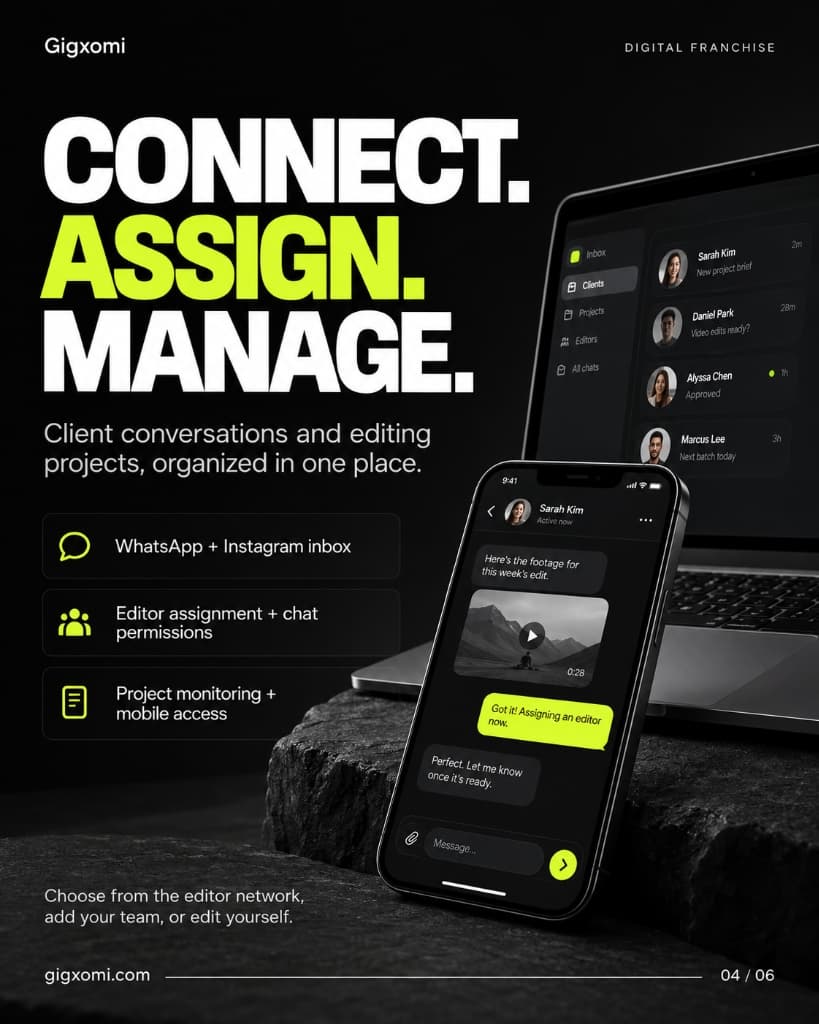
Gigxomi combines WhatsApp client intake, masked two-lane editor communication, internal manager review layers, and automated UPI payouts in one connected workspace. Keep 100% of your client retainers with zero marketplace cuts.